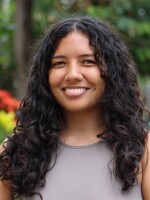
Kauaʻi resident Belkis Campos, who is from Venezuela, was visiting her family back home for the holidays when U.S. forces attacked the South American country and captured their authoritarian leader, Nicolás Maduro, on narco-terrorism charges.
Campos didn’t want to talk to HPR on the phone because she was worried about Maduro supporters overhearing her conversation and feared retaliation against her family. She shared her account of what’s happening in Venezuela through a series of text messages.
“I was honestly in shock. I felt like I was dreaming,” she said in the aftermath of Maduro’s capture.
The 31-year-old Campos and her family celebrated on Jan. 3 by taking a family photo with the Venezuelan flag. She thought her country would finally be free. But because of past threats, her family asked if she could not share the photo on social media.
Venezuelans in Hawaiʻi and abroad have complicated feelings on the U.S. airstrikes and the capture of Maduro and his wife, Cilia Flores. For many, it feels like the end of decades-long fear and suffering under political tyranny.

On Saturday, some people in Hawaiʻi and hundreds of cities in the U.S. protested against the U.S. intervention. Much of the criticism came from non-Venezuelans. They argued that President Donald Trump did not have authority to launch a strike on Venezuela without approval from Congress. Trump had said that the U.S. will temporarily run Venezuela.
Hawaiʻi's congressional delegation also condemned Trump’s actions.
“Nicolas Maduro should be held accountable for his actions, but Donald Trump's unilateral decision to overthrow his regime does nothing to make our country safer,” U.S. Sen. Mazie Hirono said in an email statement, adding that the attack will destabilize the region and put U.S. lives at risk.

But statements from protesters and commenters on social media against the U.S. airstrikes worry Campos and other Venezuelans.
“Online, it’s worrisome for me to read Americans say things like ‘Hands off Venezuela,’ or they kidnapped their president because they want oil,” Campos wrote in a text message. “Maduro is not our president. He is probably the biggest drug lord in modern history.”
Since becoming president of Venezuela in 2013, Maduro has been accused by Venezuelans of electoral fraud, undermining democracy and violating human rights. He’s also been accused of drug trafficking and working with the cartels.
The collapse of the Venezuelan economy has set off one of the largest migration movements in Latin American history. At least 7.9 million Venezuelans have fled the country, according to the United Nations Refugee Agency. They left due to soaring crime rates, low minimum wage and inflation.

'This was the only way'
Oʻahu resident Rafael Cuello, 34, and his family moved from Venezuela to the U.S. in 2019 in search of opportunities, stability and safety.
Cuello was also in the Venezuelan army from 2013 to 2019. He said that while serving in the military under Maduro’s leadership, he saw firsthand how it became politicized.
“We were not at the service of Venezuelan people. We were at the service of the government," he said.
When he saw the Jan. 3 news, he felt overwhelmed.
“It is unfortunate the way the events happened and how Maduro was captured, but this was the only way,” he said.

Trump’s decision to launch military action and extract Maduro has been a years-long standoff in Caracas. On Monday, Maduro and his wife pleaded not guilty to charges of narco-terrorism, conspiracy, cocaine-importation conspiracy and weapons charges at a federal court in New York.
Protesters have raised concerns that the United States’ involvement in running Venezuela might have the country set up like other Latin American countries.
Cuello said there’s a misunderstanding about the events in Venezuela.
“There is no war. There is no invasion,” he told HPR. “It was just an extraction of an illegal, illegitimate, so-called president that is a narco-terrorist, head of a drug cartel and is a really dangerous person.”
Until the 1990s, Venezuela had one of the most established democracies in Latin America. The country is now called the United Socialist Party of Venezuela, founded by former President Hugo Chávez.
Venezuela is also home to the world’s largest proven oil reserves.
“In the ‘80s and ‘90s, Venezuela was projected to be a power in South America because of the discovery of oil and all the industry that was booming,” Cuello said.
Chávez, who was president from 1999 to 2013, led the "Bolivarian Revolution" through socialist policies.

But Cuello said his policies were detrimental to Venezuelan residents.
“They didn't diversify the production of the country, so we were relying on the income that was coming from oil entirely,” he said.
When Maduro became president in 2013, many Venezuelans say that the Venezuelan economy significantly worsened.
“The minimum wage is on the floor,” Cuello said, adding that it’s $3 per month. “People survive with remittances from family abroad, having multiple jobs, or they become entrepreneurs doing something from bakery, accessories and sales.”
In 2024, opposition leader María Corina Machado was barred by the Maduro regime from running in the presidential race.
Campos said there have been many calls for change. She participated in protests in 2013 and 2017 against Maduro. But she said it’s dangerous to speak up against the Venezuelan government.
“So many innocent protesters were murdered by the National Guard and police officers, and the world watched and ignored this,” she said. “We ran literally for our lives in pure panic.”

A glimmer of hope
Many Venezuelans say there’s a lot of uncertainty about the country’s future but feel that the decades-long regime may finally come to an end.
“My family and I are hoping for the future and this nightmare finally ends. Extracting Maduro is not the end to this, the prosecution has intensified and now there isn’t police and national guards on the streets,” said Campos, alleging that there is a paramilitary government in Venezuela called “tupamarcos,” which she described as men dressed in black with face covers and armed with guns on the streets, checking people’s phone for anything that’s anti-Maduro.
Campos said that Machado would be the “perfect leader” for their home country.
“She has always stood against injustice and the narcos that are running our country,” Campos said. “She has been working tirelessly for over a decade, to train everyday citizens to know how to identify election fraud.”
As for Cuello, he wants Venezuela to remain an independent country.
“We are not naive, and we know Trump wants our oil,” he said. “In the past the U.S. invested millions of infrastructure that was expropriated by the government as part of their nationalization of companies, so he wants that back and we get that. But all should be negotiated once we restore democracy and freedom for the people.”
Hawaiʻi Public Radio exists to serve all of Hawai’i, and it’s the people of Hawai’i who keep us independent and strong. Help keep us strong to serve you in the future. Donate today.