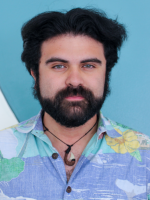
Arthur Sze is the 25th U.S. Poet Laureate and a former Merwin Conservancy resident, and he’s in town for two free poetry events this Friday and Saturday.
These events mark the start of his “Words Bridging Worlds” tour, a literary project that offers public events and workshops to share his passion for poetry and translation.

Sze is known for his translations of ancient Tang Chinese poetry into English, and as poet laureate he’s made the theme of sharing and diversifying meaning across languages the focus of his work.
He spoke with HPR to share more about the poetry he’s created and the works that inspire him.
Interview Highlights
On his book, “Transient Worlds”
ARTHUR SZE: In my first year, I assembled this book, "Transient Worlds," on translating poetry, and it features 22 poems from 13 different languages around the world, and it brings poetry from many different languages and cultures into conversation, and I wanted the book to be very inviting, so that instead of most books will say, "Here's the original poem, here's the translation, I did things like, "Here's the original poem in Chinese. Here are three different translations in English. Each one can provide a lens or some vision of what's happening in the original, but no one translation is definitive. There's no such thing as that. And the other thing I wanted to do was make the book very inviting. So in that first zone, I invite the reader to make their own translation of the Chinese poem.

On the arts of translation and poetry
SZE: When I read translations of ancient Chinese poetry translated into English years ago, I felt really uncomfortable because many of the translations had voices. The speakers sounded like they lived 100 years ago, or their use of the language, the diction, felt dated. And I call my book “Transient Worlds” because I believe translations by nature are ephemeral, because language is always changing, or vocabulary, or syntax, or diction is always changing. You can have a wonderful translation, but it will only be good for a certain amount of time, and that's not a bad thing. Each generation needs to remake, if the poem is good, their own translation. So one of the things I'm looking for in a good translation is a voice that is contemporary and alive, and to feel that the language has a kind of rigor and spontaneity behind it. And yes, there's no one way to do it.

On starting his “Words Bridging Worlds” Tour in Honolulu
SZE: I really wanted to start with Honolulu because I feel like it's not just on a literal level, Hawaiʻi is at a crossroads in the Pacific. So it has influences, you know, influx from Chinese immigrants, Japanese immigrants from the Philippines, from Okinawa, from you know, the Southern Pacific. It's a confluence, amazing confluence of cultures and languages, and I thought, well, on a literal level, that's true — but also symbolically, what a great place to start this idea that, yes, we live in a world with many different divisions and differences, and yet poetry brings people together, and really good poems helps us connect and listen and pay attention to each other, and so I thought this Honolulu would be the perfect place to start. So I'm really thrilled to be here.
The first event of the “Words Bridging Worlds” Tour will take place on Friday, Sept. 18 at 6 PM at the Mission Memorial Auditorium. More information about future events can be found here.
This story aired on The Conversation on Sept. 18, 2026. The Conversation airs weekdays at 11 a.m. Jinwook Lee adapted this story for the web.